Stadtpark in Vienna: Where History, Music and Nature Meet
In the heart of Vienna, Stadtpark offers travelers a rare combination of landscaped gardens, cultural history and musical heritage. Opened on August 21, 1862, Stadtpark was Vienna’s first public municipal park and remains one of the city’s most beloved green spaces. Covering approximately 95,900 square meters, the park stretches from the Ringstraße in Vienna’s first district into the Landstraße district, with the Wien River flowing through its center.
From City Walls to Public Park
The origins of Stadtpark are closely connected with Vienna’s transformation during the 19th century. After the medieval city walls were demolished, Vienna embarked on an ambitious program of urban modernization, including construction of the Ringstraße. The area that would become Stadtpark had previously been known as the Wasserglacis, a popular open-air promenade and recreational area.
City officials recognized that the rapidly growing population needed accessible recreational space. Landscape painter Joseph Selleny created the initial design, inspired by the English landscape-garden tradition, while Rudolf Siebeck, Vienna’s first municipal gardener, supervised its realization. Rather than creating a rigid formal garden, they designed a picturesque landscape of winding paths, lawns, groves, flowerbeds and water features.
The Wien River divides the park into two sections. The smaller section on the Landstraße side was added in 1863, and bridges eventually connected the two areas. Today, the river, bridges, mature trees and open lawns give Stadtpark a distinctive character that contrasts with the dense architecture of central Vienna.
A Park Filled With Music
Stadtpark is particularly famous for its remarkable collection of monuments and sculptures. The City of Vienna describes it as having more monuments and sculptures than any other Vienna park, making a walk through the gardens almost like an outdoor museum devoted to the city’s cultural history.
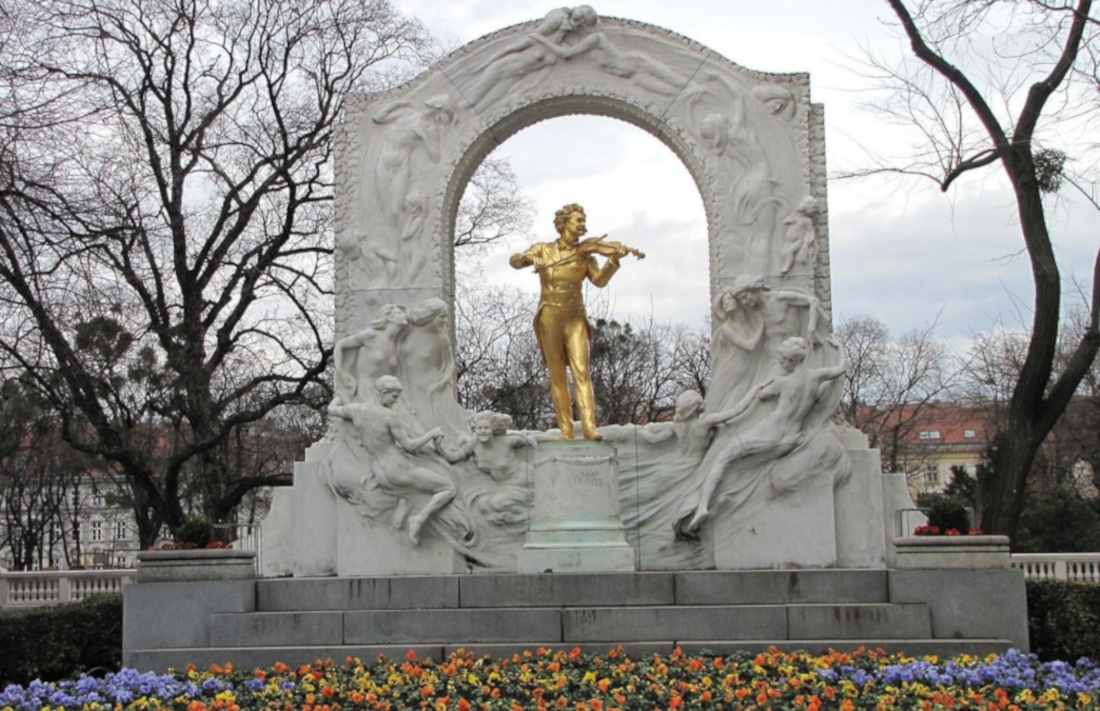
The most famous is undoubtedly the Johann Strauss Monument. Created by sculptor Edmund Hellmer, the monument depicts Johann Strauss II, the celebrated “Waltz King,” holding his violin. The bronze figure is covered in gold and stands before an ornate marble arch.
The monument was unveiled on June 21, 1921—22 years after Strauss’s death. Its creation had been proposed by a memorial committee established in 1904, but fundraising difficulties and World War I delayed the project. At the unveiling, the Vienna Philharmonic performed Strauss’s famous The Blue Danube.
Strauss is not the only composer honored here. The Schubert Monument commemorates Franz Schubert, one of Vienna’s most important musical figures. Unveiled in 1872, the marble monument was created by sculptor Carl Kundmann, with a pedestal incorporating reliefs representing aspects of Schubert’s musical world. The Vienna Men’s Choral Society helped finance the project through concerts and fundraising.
Visitors can also find monuments honoring composers Anton Bruckner, Franz Lehár and Robert Stolz. Together, these statues transform Stadtpark into a celebration of Vienna’s extraordinary musical tradition. Other monuments commemorate figures from the city’s artistic and civic history, including painter Hans Makart and former mayor Andreas Zelinka.
The Kursalon and Vienna’s Musical Legacy
Music is embedded in the park’s history beyond its monuments. The elegant Kursalon, overlooking Stadtpark, opened in 1867. Originally intended for the serving of mineral water, it was initially not supposed to host music or dancing. Viennese residents, however, soon found ways to turn its terrace into an informal entertainment venue. By 1868, concerts were officially permitted, and the Strauss brothers became associated with performances there.
The park also contains the historic Meierei, originally built as a milk-drinking pavilion in 1903 and later transformed into a restaurant. Art Nouveau architecture, including elements associated with the Wien River, adds another layer to Stadtpark’s cultural appeal.
A Popular Vienna Landmark
Stadtpark remains a remarkably popular destination for both residents and international travelers. However, unlike ticketed attractions, the park has no turnstiles or admission system, so there is no reliable official annual visitor count for the entire park. Vienna’s tourism authority describes it as one of the city’s most visited green spaces.
Individual events demonstrate the enormous visitor capacity of the park. The Vienna Genuss-Festival, for example, attracted more than 150,000 visitors during its 2026 edition alone. Older editions have also drawn tens of thousands of visitors over only a few days. These figures should not be confused with annual park visitation, but they illustrate Stadtpark’s importance as a major public gathering place.
Today, Stadtpark remains one of Vienna’s most rewarding places to experience the city at a slower pace. Visitors can stroll beneath mature trees, admire flowerbeds and the pond, cross the Wien River, discover historic architecture and stand before monuments celebrating some of Europe’s greatest composers. Most memorable of all is the golden Strauss statue—a fitting symbol of Vienna itself, where music, history and everyday urban life continue to share the same stage.
Photo: Pixabay